Introduction
A waste bin does more than hold discarded material. The right bin can make waste segregation easier, improve cleanliness, and help people build better disposal habits. For shops, schools, and offices, recycled plastic bins offer another advantage: they can give recovered plastic a useful second life.
Recycled plastic bins can support waste segregation when businesses select the right size, material, colour, label, and placement. They also fit naturally into a circular economy approach, where plastic waste moves through collection, sorting, recycling, and manufacturing instead of going directly toward disposal.
This guide explains how recycled plastic bins work, where different types fit, how recycled plastic becomes a finished bin, and what organisations should consider before purchasing them.
What Are Recycled Plastic Bins?
Recycled plastic bins are waste containers manufactured using recycled plastic resin or a combination of recycled and virgin material. The recycled feedstock can come from suitable post-consumer or post-industrial plastic waste.
The final bin may use polymers such as HDPE or PP, depending on the product design and manufacturing requirements. Each polymer has different characteristics, so recyclers must sort plastic correctly before processing it.
A recycled-content bin should not automatically be described as completely recycled. Buyers should ask suppliers about the percentage and type of recycled material used.
Common Recycled Plastics Used in Bins
Recycled HDPE can provide good impact resistance and durability for many rigid products. It commonly appears in containers and other robust plastic applications.
Recycled PP offers useful stiffness and strength and can suit various injection-molded products.
The correct polymer depends on the intended load, shape, manufacturing method, exposure conditions, and required service life.
Recycled Content vs Recyclability
These two terms describe different things.
A recycled-content bin contains material recovered from earlier plastic use. A recyclable bin can potentially enter a suitable recycling stream after its useful life.
A product can have recycled content while also remaining recyclable. Buyers should consider both characteristics when evaluating sustainability.
Why Shops, Schools, and Offices Need Better Waste Bins
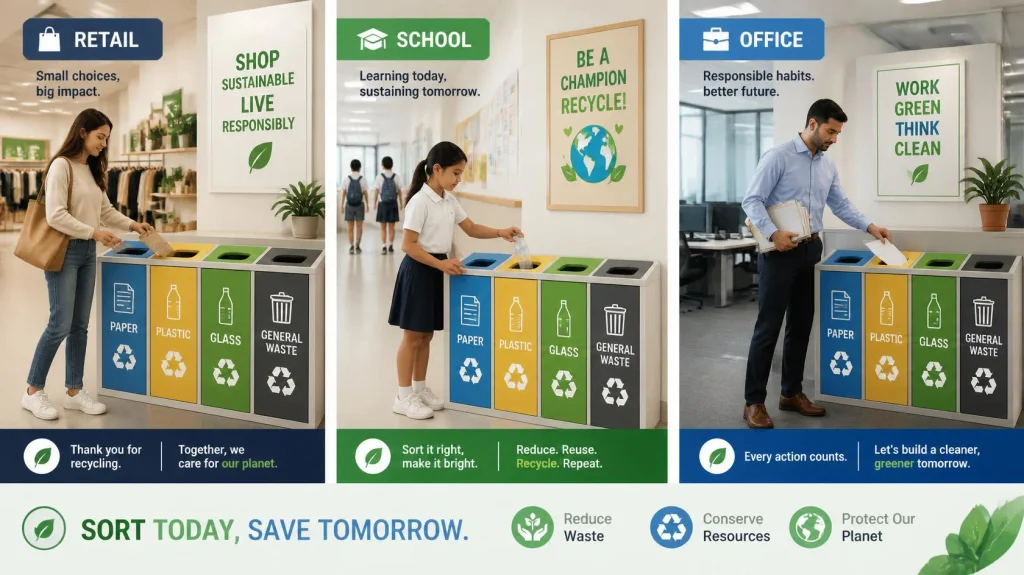
Waste segregation only works when people have an easy and visible way to separate different waste streams.
India’s Solid Waste Management Rules, 2026 introduced mandatory four-stream segregation at source: wet waste, dry waste, sanitary waste, and special care waste. The rules came into force on April 1, 2026.
This makes bin placement and identification more important for organisations that generate different types of waste.
Shops
Retail shops can generate packaging film, cardboard, bottles, food waste, and other materials. A properly positioned dry-waste bin can help staff and customers keep recyclable materials separate from wet waste.
Small shops may need compact bins near counters or back-of-house areas. Larger stores can use multiple collection points.
Schools
Schools create an opportunity to combine practical waste management with environmental education.
Students can learn segregation through clearly labelled bins placed in classrooms, corridors, cafeterias, and outdoor areas. The bin itself becomes part of an everyday awareness system.
Schools can also use recycling activities to explain what happens after collection. This helps students understand that putting plastic into the correct bin is only the first step.
Offices
Offices commonly generate paper, packaging, food waste, beverage containers, and other dry waste.
Separate collection points near workstations, pantry areas, printing zones, and common spaces can reduce mixing. Offices can also use signage to explain what belongs in each bin.
For larger workplaces, waste management should connect bin placement with collection schedules, storage areas, and authorised waste handlers.
How Recycled Plastic Becomes a Waste Bin
A durable recycled plastic bin starts with suitable feedstock. Recycling quality depends heavily on what enters the recycling system.
Collection and Sorting
Plastic waste enters collection systems from households, commercial establishments, institutions, and other sources. A material recovery facility, commonly called an MRF, can help separate recyclable materials from mixed waste.
Recyclers classify materials according to polymer type, colour, contamination, and intended application.
HDPE, LDPE, PP, PET, and other polymers require different processing routes. Mixing incompatible materials can affect the properties of the final recycled resin.
Cleaning and Preparation
Sorted plastic may contain labels, dirt, food residue, paper, metal pieces, or other unwanted materials.
The recycling process therefore includes preparation and, where appropriate, washing to remove contaminants. Proper preparation helps improve feedstock quality before further processing.
Shredding and Granulation
Suitable plastic moves through shredding or size-reduction equipment. Granulation produces smaller and more consistent plastic pieces.
At Kerala Ecoplas, this type of material preparation forms an important part of the journey from discarded plastic toward reusable material. The objective is not simply to reduce waste volume. The process aims to recover useful plastic for another application.
Reprocessing and Manufacturing
Prepared plastic can undergo further processing to create recycled resin or other usable material. Manufacturers can then use the material to produce suitable products, including certain types of rigid bins.
The exact manufacturing process depends on the polymer, product design, recycled content, and performance requirements.
Choosing Recycled Plastic Bins for Different Locations
A single bin design does not suit every environment.
Choosing Bins for Shops
Retailers should consider:
- Available floor space
- Customer traffic
- Waste volume
- Indoor or outdoor placement
- Ease of cleaning
- Colour and signage
- Collection frequency
A compact bin may work near a checkout area, while a larger container may suit a stockroom or service area.
Choosing Bins for Schools
Schools should prioritise visibility and simple instructions.
Bins should use clear labels and recognisable symbols. Colour coding can help users identify waste streams quickly, but organisations should follow the applicable local waste-management system rather than assuming that one colour scheme works everywhere.
Schools should also consider rounded or safe edges, stable construction, easy cleaning, and suitable placement around food-service areas.
Choosing Bins for Offices
Offices need a balance between appearance, capacity, convenience, and segregation.
A bin placed too far from users may encourage improper disposal. A bin placed beside a mixed-waste collection point without clear labels may also fail to achieve segregation.
Offices can create collection stations with clearly identified compartments and position them where employees naturally dispose of waste.
Colour Coding and Labelling Matter
A bin only supports segregation when users understand what belongs inside it.
Colour coding provides a quick visual signal. Labels provide the detailed instruction.
For example, a dry-waste station might display words and icons for paper, plastic packaging, metal containers, or other accepted materials. A wet-waste bin can show food scraps and other permitted organic material.
Organisations should avoid relying on colour alone. Labels, symbols, and examples reduce confusion, especially in schools and public-facing locations.
The current national solid-waste framework emphasises source segregation because separating materials at the point of generation improves recovery and downstream processing.
Where Should Recycled Plastic Bins Be Placed?
Placement can determine whether a segregation system succeeds.
High-Traffic Areas
Shops and offices should place bins near areas where people naturally generate waste. Useful locations include entrances, counters, pantry areas, printing zones, and shared spaces.
Food Areas
Canteens and staff kitchens often generate wet and dry waste together. Separate, clearly labelled containers can help prevent food residue from contaminating recyclable material.
Outdoor Areas
Outdoor bins need additional attention to rain, sunlight, wind, and handling. The selected product should match the conditions rather than using an indoor bin outdoors simply because it has a lower purchase price.
Collection Points
Bins should also connect to a practical collection route. A beautifully segregated bin becomes ineffective if workers later mix all streams during collection.
Kerala’s pollution-control guidance also emphasises segregated storage and handing over segregated plastic waste to appropriate local bodies, registered waste pickers, recyclers, or waste collection agencies.
Recycled Plastic Bins and the Circular Economy
A circular economy aims to keep useful materials in circulation and reduce unnecessary resource loss.
A recycled plastic bin can become part of that system in two ways.
First, it gives suitable recovered plastic a new product application. Second, a durable bin can remain in use for a long period before becoming waste itself.
The bigger opportunity comes when the organisation also plans what happens to the bin after use.
A business can create a simple material loop:
This approach connects purchasing decisions with waste management rather than treating them as separate activities.
Recycled Plastic Bins and Environmental Claims
Businesses should use precise language when communicating sustainability.
A recycled plastic bin may contain recycled material, but that does not mean it has zero environmental impact. Manufacturing, transport, cleaning, maintenance, and eventual disposal all require consideration.
Avoid unsupported claims such as “100% eco-friendly,” “zero-impact,” or “completely sustainable.”
Instead, businesses can communicate verifiable information such as:
- Recycled plastic content
- Polymer type
- Product durability
- Intended recycling route
- Supplier documentation
- Waste segregation purpose
This approach gives customers and employees useful information without overstating environmental benefits.
What Organisations Should Check Before Buying
A low purchase price does not always mean lower long-term cost.
Buyers should consider durability, cleaning requirements, replacement frequency, collection compatibility, and the availability of spare parts or replacement components where applicable.
They should also check whether the bin can withstand the environment where they plan to use it.
For example, a school outdoor area may require a different product from an air-conditioned office. A busy retail store may need stronger construction because staff empty and move the bins frequently.
Questions for Suppliers
Before placing an order, ask:
- What type of recycled plastic does the product contain?
- What percentage of the material comes from recycled sources?
- Is the recycled material post-consumer, post-industrial, or a combination?
- What waste streams does the bin support?
- Can the bin withstand the intended indoor or outdoor conditions?
- How should staff clean and maintain it?
- Can the product itself enter a recycling pathway at end of life?
- What documentation supports the recycled-content claim?
Additional Information: Recycled Plastic Bin Selection Checklist
| Requirement | Shop | School | Office |
| Compact footprint | High priority | Medium priority | High priority |
| Clear visual labels | High priority | Very high priority | High priority |
| Multiple waste streams | Useful | Essential for learning | Highly useful |
| Easy cleaning | High priority | Very high priority | High priority |
| Outdoor durability | Depends on location | Often important | Usually lower priority |
| Child-safe design | Not usually required | Important | Not usually required |
| Attractive appearance | Important | Useful | Important |
| Large capacity | Depends on waste volume | Useful in common areas | Useful in shared areas |
| Collection compatibility | Essential | Essential | Essential |
| Recycled-content documentation | Recommended | Recommended | Recommended |
| End-of-life recycling plan | Recommended | Recommended | Recommended |
Conclusion
Recycled plastic bins can support both practical waste management and responsible material use in shops, schools, and offices. Their value comes from more than the recycled material itself. Correct segregation, clear labelling, suitable placement, regular collection, and responsible end-of-life management all influence the result.
For organisations, the strongest approach is to treat bins as part of a complete waste-management system. The goal is to keep waste streams separate from the point of disposal and give recyclable materials a better chance of reaching appropriate recovery channels.
Kerala Ecoplas works across plastic collection, sorting, shredding, reprocessing, recycled products, and environmental awareness. If your organisation wants to improve plastic segregation or explore recycled plastic products, connect with Kerala Ecoplas for a practical approach.
FAQs
Are recycled plastic bins durable?
They can be durable when manufacturers use suitable recycled resin and design the product for its intended application. Durability depends on the polymer, recycled material quality, manufacturing process, thickness, design, and operating conditions.
Are recycled plastic bins suitable for schools?
Yes. They can work well in classrooms, corridors, cafeterias, and outdoor areas when organisations select safe, stable, easy-to-clean designs and provide clear segregation instructions.
Which plastic is commonly used to make recycled bins?
Recycled HDPE and PP can suit many rigid-bin applications. The appropriate polymer depends on the required strength, stiffness, impact resistance, manufacturing process, and product design.
Can recycled plastic bins be recycled again?
Potentially, yes. The recycling route depends on the polymer, additives, contamination, product construction, and availability of a suitable collection and processing system.
Do colour-coded bins guarantee proper waste segregation?
No. Colour coding helps users identify waste streams, but it works best with clear labels, correct placement, user awareness, and a collection system that keeps segregated materials separate. India’s current solid-waste framework places strong emphasis on source segregation and recovery.